
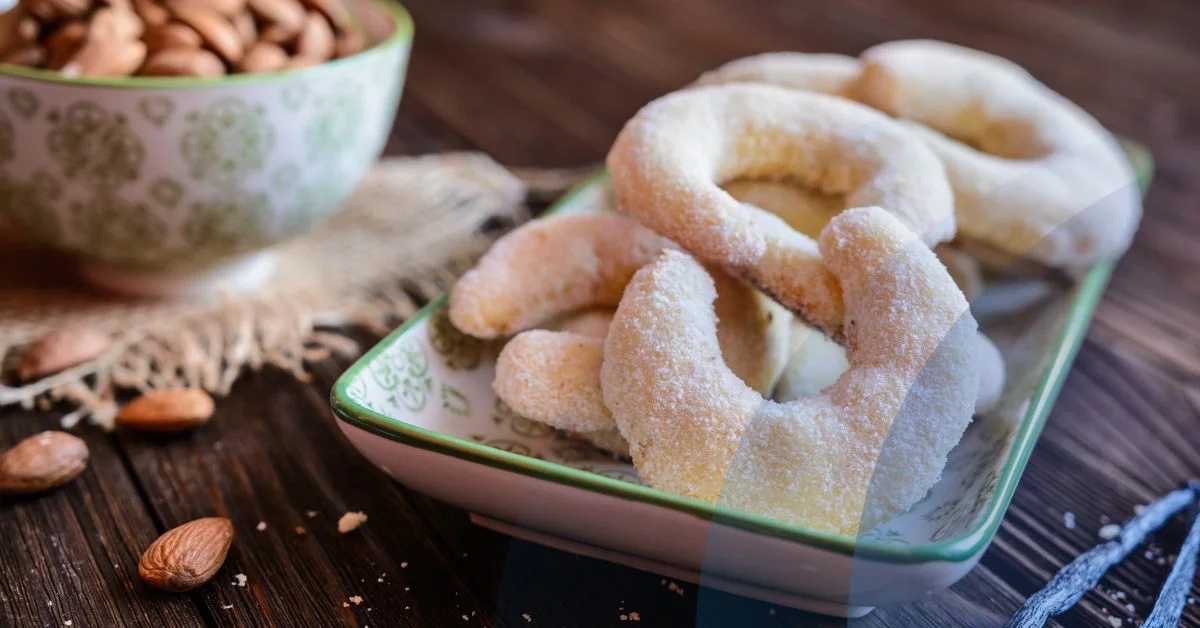
Some of my favorite memories from childhood begin in my grandmother’s kitchen with the aroma of almond crescents baking. These nutty, buttery, and just a little bit magical treats always signaled that a celebration was coming. She shaped each one by hand, forming delicate little half-moons dusted with powdered sugar. To her, these cookies weren’t just treats; they were a heritage passed down, a way to bring people together.
What I didn’t realize until I was older is that almond crescents aren’t unique to my family. Many cultures around the world have their own version of this simple, comforting recipe. In Austria, they’re called Vanillekipferl. In the Middle East, they appear as ma’amoul. Across Europe and North Africa, you’ll find half-moon pastries with almond, pistachio, walnut, or dates. Each variation has its own flavor, texture, and story, but the shape remains consistent: a crescent, symbolizing connection, hospitality, and tradition.
And that’s when it hit me: almond crescents are a lot like people.
Shared Shape, Unique Ingredients
At The Omnia Group, we talk a lot about understanding what makes people tick and how each individual brings their own “mix of ingredients” to work. No two people are exactly the same, even if they share the same role, goals, or responsibilities. Our behavioral assessment reveals this beautifully. While we often share common traits and core motivators, our expression of them, our “recipe” in a sense, is uniquely our own.
Some of us are bold and decisive like a cookie with an extra punch of almond. Others are steady, detail-oriented, and structured, more powdered sugar than crunch. Some thrive in collaboration; others shine in independent, focused work. These differences aren’t obstacles; they’re the ingredients of strong, high-performing teams.
Tradition Evolves and So Do We
Just as almond crescents adapt across cultures, workplaces grow stronger when they embrace a variety of behavioral styles. A team becomes richer when every personality is recognized, valued, and utilized. Leaders who understand this can shape their communication and management style to connect with each “recipe,” ensuring everyone feels seen and supported.
My grandmother kept her almond crescent recipe carefully written on a well-loved index card, worn at the edges, dotted with flour, and pulled out for every special occasion. She followed it faithfully, but she still put her own touch on each batch, adjusting based on the moment and the people she was baking for. In the workplace, we may also have “recipes” for how teams function, but no team is ever exactly the same. Tools like Omnia’s behavioral assessment give leaders a guide they can rely on while still allowing room for personalization, helping them bring out the best in every “variation.”
Different Flavors, Shared Connections
Whether it’s an Austrian Kipferl, a Greek kourabiedes, or my grandmother’s almond crescents, these cookies remind us that we’re all connected through shared human traditions, even as we celebrate what makes us unique.
The same is true in our workplaces: we thrive when we honor the common ground while appreciating every individual’s distinctive flavor.
So, as we move through the busy weeks ahead, consider this: What unique “ingredients” do you bring to your team, and how can you make space to savor the strengths of others?
If you’d like help uncovering those ingredients, we’re always here to serve up insight. And maybe a cookie or two.
Grandma Bea’s Almond Crescent Recipe:
Ingredients:
1 cup (2 sticks) unsalted butter
½ cup confectioners’ sugar
1 tsp vanilla extract
2 ¼ cups sifted all-purpose flour
¼ tsp salt
¾ cups finely chopped almonds
Directions:
- Preheat oven to 350 degrees
- Cream butter and sugar; add vanilla, flour, salt and nuts and mix well
- Form dough into balls, then roll into snakes and form dough into crescents. (approximately teaspoon sized)
- Place on ungreased baking sheet
- Bake at 350 degrees for 12-15 minutes (check for golden brown color at 10 minutes)
- While still warm, roll the crescents in confectioner’s sugar
- Repeat with one final roll in the sugar to ensure cookies are completely covered
- This recipe yields about 5 dozen cookies