
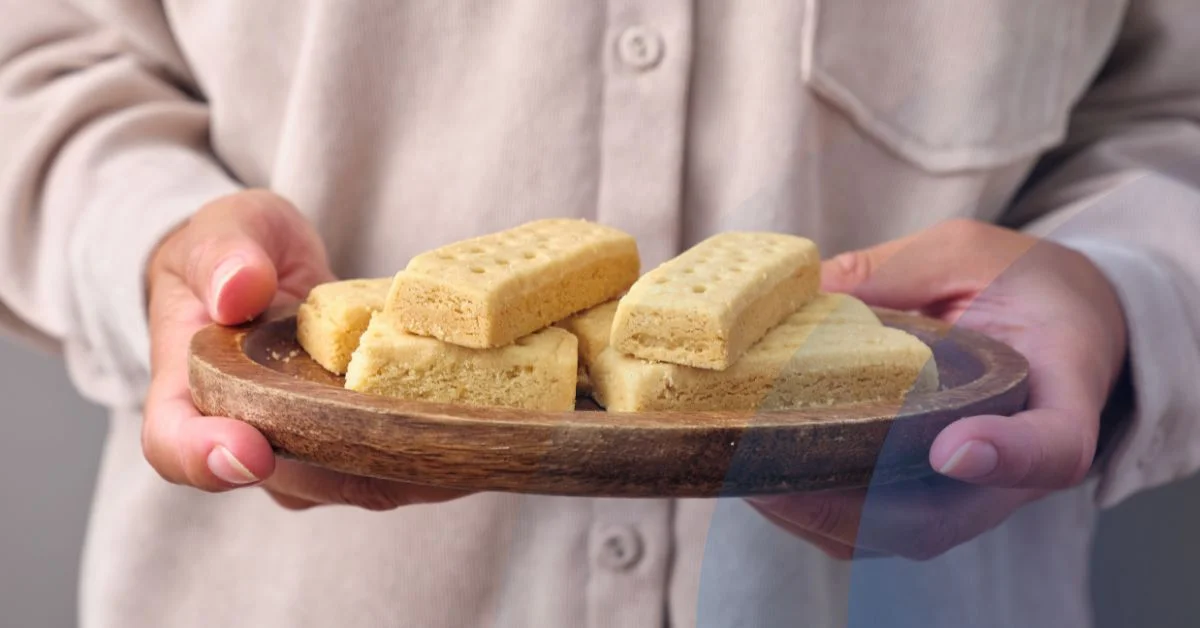
You may roll your eyes as you read the opening of this blog. I love Hallmark Christmas movies. Yes, I do, and I admit it proudly. The ones I love the most always seem to include a cookie making scene, a holiday bake-off, or most dramatically, a small family business fighting a corporate takeover and endeavoring to protect the family’s secret recipe.
In my all-time favorites, the starring cookie role is the shortbread cookie. This is my very favorite of all the Christmas cookies. The shortbread cookie uses simple ingredients, precise ratios, and offers a melt-in-your-mouth payoff when you get the mix just right. Until just a few years ago, I didn’t know how easy they were to make. I merely enjoyed them store bought or in my imagination as I watched the stars of my favorite classics, fresh from a snowball fight, enjoy decorating them while sipping hot cocoa. But when I joined Omnia and admitted my fascination with our founder, Heather Caswell, she gifted me with a fabulous and fool-proof recipe. I now get to enjoy my own home-made recipe in real life throughout the holiday.
Talent strategy in small and mid-sized businesses reminds me of my favorite holiday shortbread cookies. On the surface, they’re simple and easy to make. Just a few ingredients. But anyone who’s ever made them knows that simplicity only works when each ingredient is exactly right and used with intention.
The same is true for building a strong team. You don’t start by piling on perks, programs, or development initiatives and hope it all holds together. You start by selecting the right person for the role. You select someone whose natural behavioral traits align with what the job actually demands. When that match is off, no amount of coaching can fix it. But when it’s right, everything else blends beautifully. It’s similar to making sure you select the best sugar for your shortbread cookies. Everyday sugar just won’t do.
From there, the right leadership style and approach focused on coaching, development, and support act like the finishing touches. The core ingredient within the employee doesn’t change. Just like you can’t turn sugar into butter. But coaching powered by individual behavioral insight brings out the best in what’s already there. Behavioral assessments help leaders understand how someone is wired, how they work under pressure, and how they collaborate with others, so development efforts feel supportive instead of forced.
Just like shortbread, great talent strategy doesn’t rely on complexity. It relies on clarity, fit, and thoughtful execution. When leaders focus on getting the foundation right, matching people to roles based on who they truly are, they create teams that perform consistently, adapt under pressure, and stick around long after the holidays are over.
Before we preheat the oven, let’s ground this in data. Gallup’s latest global workplace report found engagement fell from 23% to 21% in 2024, costing the world economy an estimated $438 billion in lost productivity. What’s even more disheartening is that manager engagement dropped the most. In other words, the “bakers” matter: 70% of the variance in team engagement is due to the manager.
Disengagement isn’t just a mood; it’s a measurable drain. Multiple analyses peg the cost of replacing an employee at 30% of the first year’s salary, once you add hiring, onboarding, vacancy, and productivity losses. And when retention wobbles, SMBs pay dearly in time, budgets, and customer relationships.
So yes, this matters. Here’s how to use a shortbread mindset to build better people decisions this season and beyond.
The Shortbread Recipe: Talent “Ingredients” that Drive Results
1) Employee Behavioral Assessment (your flour)
Flour is foundational; so are behavioral insights. Valid, job-related behavioral assessments, like The Omnia Behavioral Assessment, help you predict how candidates will communicate, solve problems, and collaborate. Assessment data extends far beyond what a résumé reveals. Research shows that validated assessment tools (used appropriately with job analysis) improve fairness and predictive accuracy in hiring.
Omnia’s behavioral assessment was designed to be EEOC compliant and has been scientifically validated, with independent studies assessing reliability and predictive validity. Used across hiring and development, it gives leaders practical, job-specific insights to hire for fit and coach for performance.
2) Leadership Personality Styles (your butter)
Butter holds shortbread together; leaders do the same for teams. Gallup’s research is blunt: manager quality is the lever. Manager disengagement cascades into team disengagement and lower performance. Understanding leadership personality styles helps you tailor coaching, decision-making, and communication so managers can bring out the best in diverse teams.
Just like the shortbread recipe, take a practical approach. Use a leadership style profile to identify strengths (e.g., decisiveness, empathy, structure) and blind spots (e.g., over‑control, conflict avoidance). Then align coaching to those traits. This increases engagement, reduces errors, and boosts productivity.
3) Team Dynamics (your sugar)
Sugar gives shortbread its snap and satisfaction. In teams, “sweetness” comes from complementary strengths and clear norms. Evidence on diversity and performance tells a nuanced story: diversity’s average effects are small but positive, and outcomes improve with complex, creative tasks and supportive climates. The key is how you harness differences though, not just focusing on having them.
Diverse teams can be smarter and more innovative when leaders actively tap different perspectives. And here again, the culture of your business and leadership quality matter. Behavioral assessments help you map team dynamics (communication, pace, risk tolerance, conflict management styles) and design rituals that convert differences into decision quality.
4) Employee Development Assessment (your salt)
A pinch of salt transforms flavor; development assessments elevate performance. A structured learning and development system isn’t a “nice to have”. It’s the retention and productivity engine of your business. There are many strong links between meaningful development, productivity, and loyalty. Organizations with robust development strategies report higher profit margins and faster ramp times; employees who see growth paths stay longer and perform better.
We recommend using role-specific development assessments to benchmark capability, personalize learning paths, and measure impact. Further, offering developmental opportunities such as cross-functional projects and short-term leadership assignments ties learning to business outcomes while building a leadership pipeline for your future.
5) Company Culture (your bake time & temperature)
You can have the right ingredients and a beautifully mixed dough, but if the oven temperature is off or you remove the cookies too early, you’ll still ruin the batch. Culture is the heat, and the perfect temperature brings all the ingredients together. Culture determines whether your workforce rises or crumbles under pressure. A strong, intentional culture sets the environment for engagement, collaboration, and long-term success.
In small and mid-sized businesses especially, culture isn’t defined by a mission statement on the wall. It’s shaped by daily leadership behaviors. Do leaders listen or rush? Do they coach or correct? Do they adapt to different personality styles or expect everyone to work the same way? A healthy culture creates the right conditions for people to do their best work consistently, while a misaligned culture quietly erodes engagement, trust, and performance over time.
When culture is intentional, it acts like a steady oven temperature, bringing out the best in your people without burning them out. Behavioral insights help leaders understand how individuals experience that environment differently so culture doesn’t become a one-size-fits-all expectation. Instead, it becomes a shared foundation where people feel understood, supported, and challenged in the right ways. Get the culture right, and strong performance doesn’t just happen once, it becomes repeatable.
Your Holiday Checklist: Bake Engagement into Everyday Practices
Use this concise, practical checklist with your leaders:
Hire for Fit
- Conduct a quick job analysis to define critical behaviors needed across your teams.
- Use a validated employee behavioral assessment mapped to job-specific benchmarks; avoid “type labels” that aren’t job related.
- Combine data with structured behavioral interviewing to confirm evidence of fit.
Maximize Leadership Personality Styles
- Profile managers’ natural styles and coach to strengths and gaps.
- Train managers to leverage their self-awareness and awareness of others, and provide them training on coaching techniques.
- Set weekly one-on-ones anchored in clear outcomes and wellbeing check-ins.
Foster Team Dynamics
- Map the team’s behavioral composition to understand and leverage diversity and to harness the unique traits of all your team members.
- Assign complementary roles for complex projects to harness diverse perspectives.
- Review workload, decision rights, and conflict rituals quarterly.
Build Individualized Employee Development Strategies
- Use role specific development assessments to baseline capability and personalize upskilling plans.
- Track ramp time, role readiness, and internal mobility, and report ROI in concrete terms.
- Offer flexibility with guardrails; avoid rigid mandates that erode intent to stay. Blend on-the-job, cross-functional initiatives and short-term leadership assignments.
Focus on Company Culture
- Deploy listening tools to capture sentiment and intervene early.
- Recognize and celebrate behaviors that algin with your culture, not just outcomes.
- Integrate culture into hiring and onboarding so new hires understand and embrace it from day one.
Bringing It Home: The Shortbread Test for Leaders
This holiday season, as the shortbread trays come out, ask yourself:
- Do we consistently use employee behavioral assessments to hire and develop for role success?
- Do our leadership personality styles inform how we coach managers—the single greatest driver of engagement?
- Are we intentional about team dynamics and assigning roles that leverage complementary strengths on complex work?
- Do we measure learning ROI (ramp time, role readiness, internal mobility) using development assessments, not just completions?
- Have we cultivated a strong, values-driven company culture that reinforces trust, inclusion, and engagement every day?
If you answered “not yet” to any of these, you’re leaving performance (and shortbread-level delight) on the table.
Call to Action: Let’s Bake Your Talent Strategy Together
At Omnia, we help SMB owners, HR, and functional leaders turn talent strategy into a repeatable recipe. We remove the guesswork and give you data-driven insight. From employee behavioral assessment insights and leadership personality styles to team dynamics, employee development assessment data, and employee retention tools, we’ll partner with you to hire and develop for fit, ensuring you have the right people in the right seats who are maximized to reach their full potential.
Ready to get started? Contact our team for a complimentary consultation and demo of the Omnia Behavioral Assessment. We’ll help you benchmark key roles, assess your managers and teams, and design a development and retention plan you can execute immediately.
Keather’s Tip: Like shortbread, talent strategy rewards consistency. Measure, adjust, and keep your ratios right because the sweetest results come when you respect the recipe and the people who make it sing.
Heather’s Traditional Scottish Shortbread
Makes 18 Pieces
INGREDIENTS
- 2 cups (240 grams) all-purpose flour
- 2 sticks (230 grams) quality unsalted butter, cubed and softened at room temperature (the better the butter, the better the shortbread)
- 1/2 cup (120 grams) caster sugar or “baker’s sugar” in the U.S. (If you can’t find any, simply pulse granulated sugar in a blender until very fine. Do NOT use powdered sugar.)
- 1/2 teaspoon salt
INSTRUCTIONS
Preheat the oven to 350 degrees F. Butter a 8×8 or 9×9 inch square baking pan. You can also use a round cake pan and cut the shortbread into triangles.
- Place the caster sugar, flour, salt and butter in a food processor and pulse until it’s combined and looks like coarse breadcrumbs but is soft and pliable and comes together in a dough when you press it together between your fingers. If it’s too dry and crumbly, it needs to be pulsed a bit longer. (If using any add-ins, stir them in at this point.)
- Pour the mixture into the greased baking pan. Use your fingers and hands to firmly press down the mixture. Note: If the mixture is too dry to work with, including pricking with a fork (see below), then it was not pulsed long enough in the food processor.
- Optional: Prick the shortbread with the tines of a fork, creating rows. Some people also like to run a knife between each row of fork tines to make cutting the shortbread easier after it’s baked. You can also prick the shortbread with a fork immediately after it is done baking while it is still warm; the holes will be more pronounced this way as they have a tendency to close during baking.
- Place the shortbread on the middle rack and bake for 30-35 minutes or until light golden and firm. Let cool. Cut and serve.
Store the shortbread in an airtight container for up to several weeks. Its flavor and texture improve over time, just like your people and your businesses when we incorporate the right ingredients and follow the recipe.

Sources & Further Reading
- Global engagement trends and manager impact: Gallup; engagement fell to 21% in 2024 and cost the economy ~$438B; managers drive 70% of variance. [prnewswire.com], [inclusiongeeks.com]
- Disengagement prevalence: summaries of Gallup’s 2024 data. [teamout.com], [talkspirit.com]
- Turnover costs and calculation approaches. [hrmorning.com], [hrbench.com]
- SHRM perspectives on retention technologies and ROI of training. [shrm.org], [shrm.org]
- Employee development ROI stats and measurement practices. [getbridge.com], [intellum.com]
- Internal mobility’s impact on retention and engagement. [forbes.com]
- Diversity, team performance, and leadership context. [link.springer.com], [hbr.org]
- Best practice use of personality/behavioral assessments in hiring. [psychologytoday.com]
- Omnia validation, compliance, and use cases. [omniagroup.com], [pianational.org]
- Employee development – strategies and benefits [getbridge.com], [intellum.com]
- Prove the ROI of L&D With These 58 Stats | Bridge LMS